


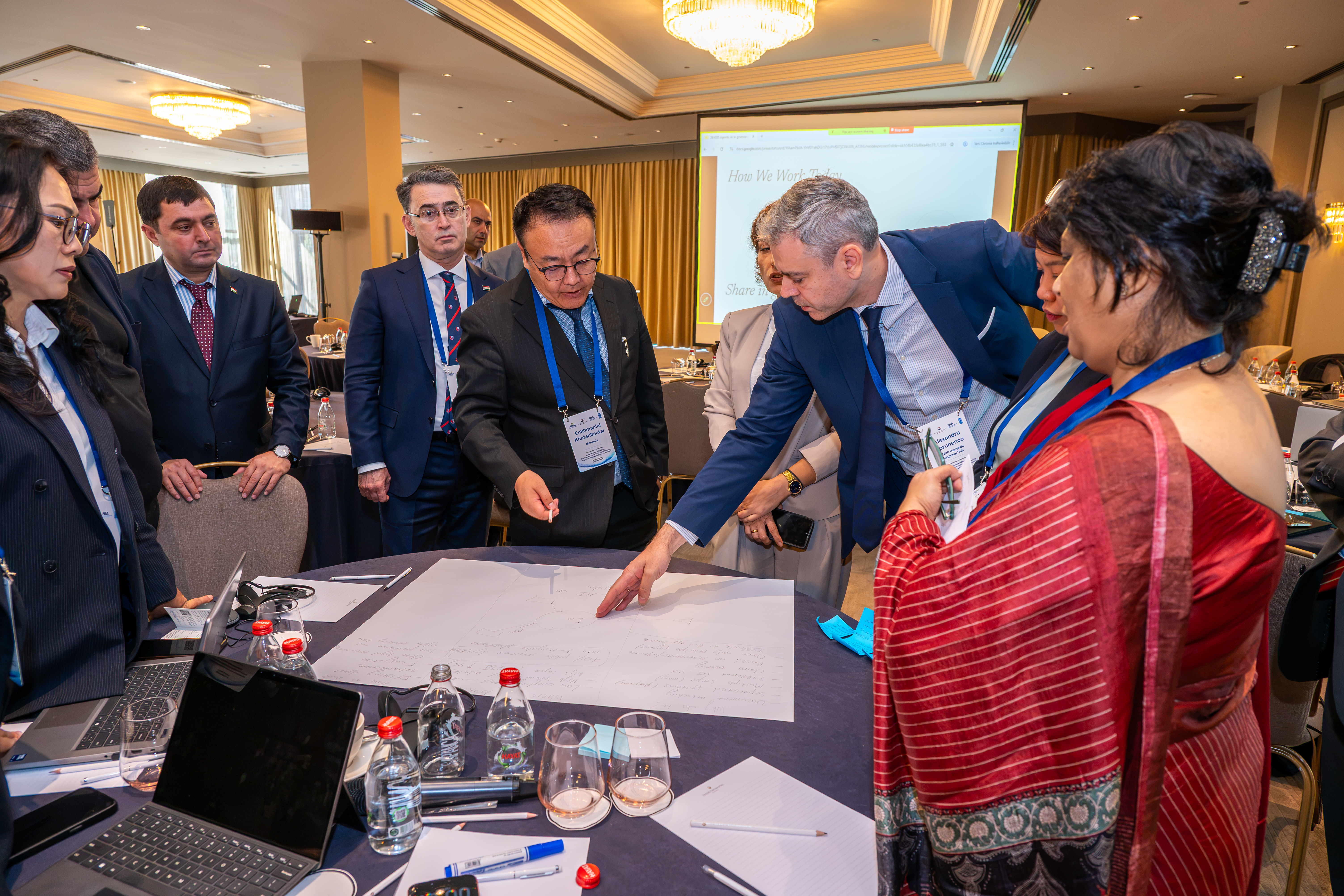
More than 60 government officials, practitioners and UNDP representatives from 14 countries gathered to discuss how to govern artificial intelligence effectively in the public interest amid rapid technological change. The interregional conference “AI Governance in Practice” took place in Istanbul.
The conference was jointly organized by the Astana Civil Service Hub (ACSH), UNDP Kazakhstan, the Ministry of the Interior and Safety (MOIS) and the National Information Society Agency (NIA) of the Republic of Korea, with support from the UNDP Istanbul Regional Hub.
In her welcoming remarks, Steliana Nedera, Manager of the UNDP Istanbul Regional Hub, highlighted the uneven pace of AI adoption and the risk of a widening digital divide, both between countries and among people with different levels of digital skills. She emphasized the importance of balancing support for innovation with appropriate AI regulation.
In turn, Osman Gazi Güçlütürk, Director General for AI at the Cybersecurity Presidency of the Republic of Türkiye, called for practical, accessible and affordable approaches to AI governance that ensure safety and security and preserve human agency in decision-making.
Dongsu Chang, Director General of the AI Government Services Bureau at the Ministry of the Interior and Safety of the Republic of Korea, introduced the “AI Government Lab”, where civil servants identify challenges in their work, test AI solutions and develop prototypes. He emphasized that technology can transform government only when staff have the skills to use it. The Republic of Korea therefore places particular emphasis on strengthening civil servants’ capabilities alongside the development of shared AI infrastructure and public services.
Alikhan Baimenov, Chairman of the Steering Committee of the Astana Civil Service Hub, noted that the world is entering an era of human–AI coexistence, in which increasingly autonomous systems demand a new level of responsibility and meaningful human oversight. He emphasized the need for stronger institutions, skills and safeguards to ensure that AI serves the public interest, protects human rights and benefits society.
Baimenov also emphasized the role of international cooperation in ensuring more equitable access to new technologies, preventing inequalities from widening and enabling countries to address shared challenges together. He highlighted the joint interregional initiative funded by the Republic of Korea, which has expanded from 7 to 12 countries since its launch in 2021 and provided training for more than 500 government officials and practitioners.
During the conference, participants explored successful practices from the Republic of Korea, in AI, from legal frameworks to its use in public services, as well as the country’s experience in digital identity and cyber resilience. Representatives from twelve countries across Central Asia, the Caucasus and the Asia-Pacific region shared their own solutions, achievements and implementation challenges.
Aruzhan Saryyeva, representative of the Ministry of Artificial Intelligence and Digital Development of the Republic of Kazakhstan, presented Kazakhstan’s experience in moving from digital public services to AI development, noting that 92% of public services are already fully digital. The country’s priorities include equipping one million citizens with AI skills over the next five years. She also highlighted the adoption of the Digital Code and a dedicated AI law, the launch of national supercomputers and the opening of the international AI center alem.ai in Astana, which brings together education, research and support for startups.
The conference provided a platform for sharing international experience and practical tools for AI governance. Participants focused on addressing public needs and ensuring accountability in the use of AI. During an interactive session, they explored where AI agents could add value in public administration and how to begin using them in their countries.
_____________________
For reference:
The conference was held as part of an interregional project funded by the Government of the Republic of Korea through the Ministry of the Interior and Safety (MOIS) and the National Information Society Agency (NIA), and implemented by UNDP Kazakhstan, utilising the capacity of the Astana Civil Service Hub (ACSH). The project aims to strengthen the capacities of civil servants in twelve countries across Central Asia (Kazakhstan, Kyrgyzstan, Tajikistan and Uzbekistan), the Caucasus (Armenia, Azerbaijan and Georgia) and the Asia-Pacific region (Bangladesh, Cambodia, Lao PDR, Mongolia and the Philippines). Its activities include workshops, research and study visits to the Republic of Korea to support digital transformation and advance digital government in participating countries.
